Checklist : How to Choose the right Business Management Software

Blog

·

15/05/2026

·

Reading time 3 min

Imagine your organization as a living, growing organism. Every team, every process, every department is a moving part that must work in harmony. Now imagine trying to control it with a single rigid tool that can’t adapt, or worse, one that breaks whenever you add a new function.


That’s the reality many businesses face when choosing an all-in-one Business Management Platform.


This guide takes you beyond marketing promises and feature lists. Inside, you’ll find a practical, principle-driven checklist that will help you evaluate platforms confidently and select one that is future-ready, modular, and truly adaptable.

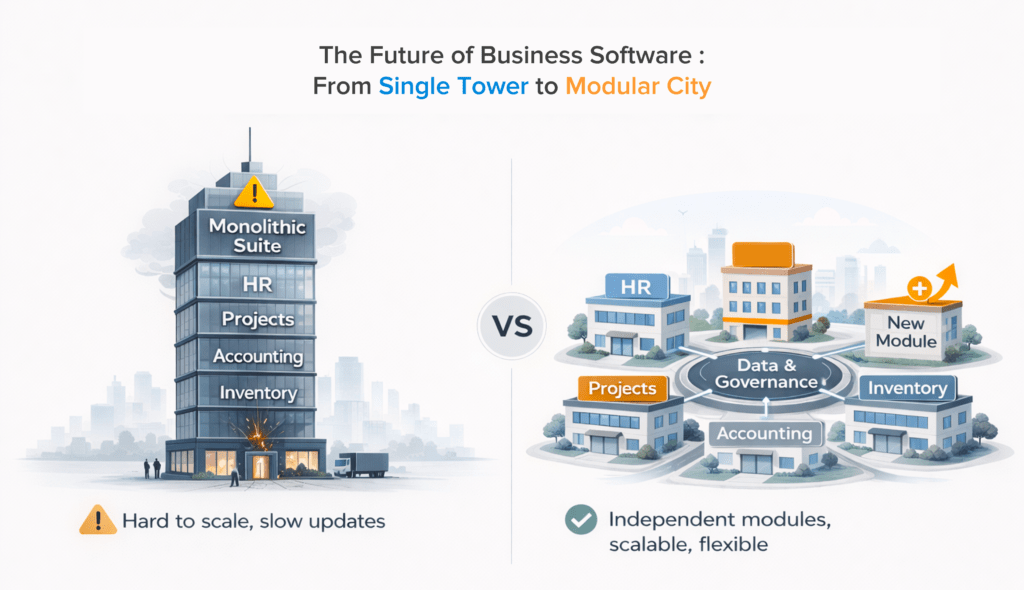
Why your Business Software should be more like a city, not a single building

Imagine your organization as a busy city. Departments are neighborhoods, teams are streets, and workflows are the traffic that keeps everything moving.


Now picture running this city from a single huge skyscraper where everything is stacked together. If one elevator breaks, HR, Finance, and Projects all come to a standstill.


This is exactly what happens with traditional monolithic business software :


  • Everything tightly coupled: One change can disrupt multiple workflows.
  • Difficult to scale: Adding new departments or processes often requires costly reconfiguration.
  • Slow to evolve: Upgrades and new features are risky and slow to implement.
  • Limited visibility: Leadership struggles to get real-time insights across the organization.

The “single skyscraper” approach may look efficient at first.


One vendor. One contract. One interface.


But as your organization grows, complexity multiplies..

Now imagine a city designed with modular districts:


  • Each district (module) operates independently but shares central infrastructure like roads, utilities, and governance.
  • New districts can be added without disrupting others.
  • The city can expand organically while remaining efficient and well-connected.
the future of business software

Checklist: How to evaluate your Business Management Software

For each statement below, assign :


  • 2 points = Fully supported
  • 1 point = Partially supported / unclear
  • 0 points = Not supported


Score Interpretation

41–50 points

Strategic platform
Architecturally robust, scalable, future-ready. Likely built on modular or micro-app principles.

31–40 points

Operational but limited
Works today, but structural limitations may surface as complexity increases.

21–30 points

Risk of rigidity
Short-term fit; long-term challenges likely.

0–20 points

High-risk platform
High risk of performance, integration, and scalability issues.

1. Architecture & Modularity

☐ The platform offers a modular architecture where only the necessary modules are activated.


☐ Each module/ functional domain operates independently


☐ A central core ensures consistent governance and business rules across all modules.


☐ Modules can be deployed or scaled independently.


☐ The system is API-first by design.

2. Adaptability & Future readiness

☐ Workflows can be modified/ redesigned without rewriting core code.


☐ New departments or business units can be added seamlessly.


☐ The platform supports low-code or configuration-based extensions.


☐ The vendor has a clear product roadmap aligned with long-term evolution.


☐ Organizational restructuring does not require reengineering the system.

3. Scalability & Performance

☐ The platform supports multi-entity and multi-country operations.


☐ Performance benchmarks are documented and measurable.


☐ The system maintains speed under high concurrency.


☐ Modules can scale independently based on operational demand.


☐ Infrastructure flexibility (cloud, hybrid, on-premise) is available.

4. Integration & openness

☐ APIs are fully documented and accessible.


☐ Third-party integrations are supported without workaround solutions.


☐ Data export is structured and unrestricted.


☐ You can switch vendors without major disruption.

5. Security & Governance

☐ Data handling and storage comply with regulatory requirements, including GDPR and ISO standards (e.g., ISO 27001)


☐ Audit trails are available across modules.


☐ Supports role-based access control.

6. User & Data Experience

☐ Teams have real-time visibility across workflows, KPIs, and dashboards.


☐ The platform provides a modern, intuitive user experience with web and mobile accessibility.


☐ Reports can be generated, extracted, and interpreted effortlessly.

Red Flags to avoid

🚩 Architecture is unclear or not transparently explained by the vendor


🚩 Heavy customization requires modifying core code


🚩 No clear product roadmap


🚩 No performance benchmarks


🚩 Limited API documentation


🚩 Unclear Licensing model

Final Thought: Choose structural advantage

Choosing business management software is more than picking features , it’s a structural decision. The right platform should scale, adapt, and provide operational clarity without imposing rigid constraints.


Modular, micro-app-based architectures like Elix provide upgrade-safe, independent modules, giving your organization the flexibility to evolve confidently for years to come

Content

Loading...

Evaluate your current or prospective platform with our checklist