Elix for Software Development Companies : 3 Must-Have Features
Blog
·
17/07/2026
·
Building great software today requires more than great developers.
Teams must manage Agile workflows, ensure high-quality releases, and handle growing operational complexity, all while moving faster than ever.
Yet many software development companies still rely on a patchwork of tools that slows teams down instead of accelerating them.
The solution? A unified platform built for modern development teams.
With Agile management, integrated QA, and a powerful Multi-Agent AI system, Elix helps development teams move faster, collaborate better, and deliver smarter.
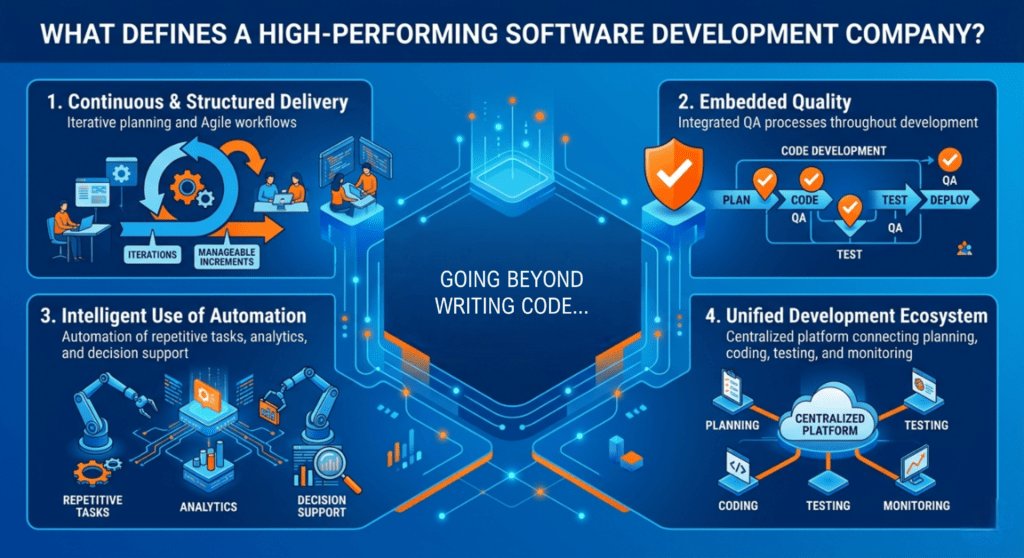
What defines a high-performing Software Development Company ?
High-performing software development companies go beyond writing code. They excel at team collaboration, workflow efficiency, and continuous value delivery.
Capability | What it means | Why it matters |
Continuous & Structured Delivery | Iterative planning and Agile workflows that break projects into manageable increments | Faster feedback, adaptability, and consistent progress across teams |
Embedded Quality | Integrated QA processes throughout development, not just at the end | Higher product reliability, fewer post-release issues, and efficient release cycles |
Intelligent use of Automation | Automation of repetitive tasks, analytics, and decision support | Developers can focus on innovation and complex problem-solving instead of manual work |
Unified Development Ecosystem | Centralized platform connecting planning, coding, testing, and monitoring | Greater visibility, stronger collaboration, and smoother workflow across teams |
➡️ Agility is non-negotiable: The faster a company can iterate, the more competitive it becomes.
➡️ Quality is built in, not added on: Continuous QA ensures fewer errors and more reliable software.
➡️ Automation drives focus: Intelligent automation allows teams to focus on impactful tasks.
➡️ Integration is the multiplier: Connecting all tools and workflows increases team efficiency and reduces friction.

From Principles to Practice : The 3 Must-Have features for Software Development Companies
To turn these principles into action, teams need a platform that brings all critical capabilities under one roof. This is where Elix comes in. Designed for software development companies, Elix combines the tools teams need to plan, execute, and optimize the entire development lifecycle.
With Elix, teams get:
- Agile Project Management to keep workflows structured and aligned across teams.
- Integrated QA Management for quality checks at every step of development.
- Role-based AI Agents to automate repetitive tasks and generate actionable insights.
In the sections below, we’ll explore each of these three essential features.
Feature 1 : Agile Project Management
Why it matters |
|
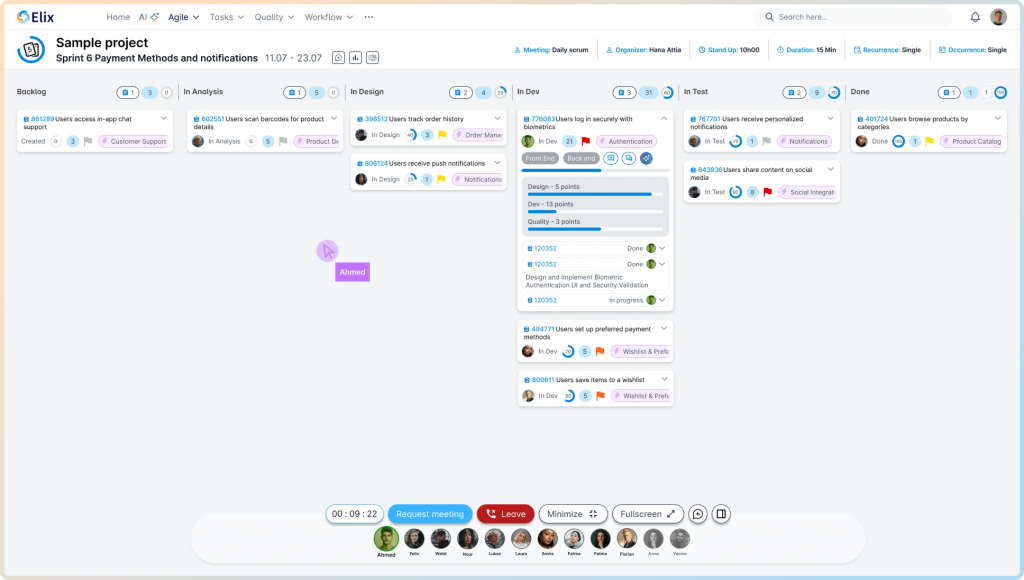
What Elix provides | Elix provides a fully integrated Agile workspace :
✅ Interactive Agile Scrum Meeting Dashboards ✅ Advanced Poker Estimation (accurate sizing of user stories) ✅ Scrum of Scrum GANTT Charts
|
Impact |
|
For more details on Agile Project Management Features, check our article : Mastering Agile Project Delivery with the Right Tools

Feature 2 : Integrated QA & Test Management
Why it matters | When testing activities are disconnected from development workflows, issues are discovered too late, leading to costly fixes and unstable releases. |
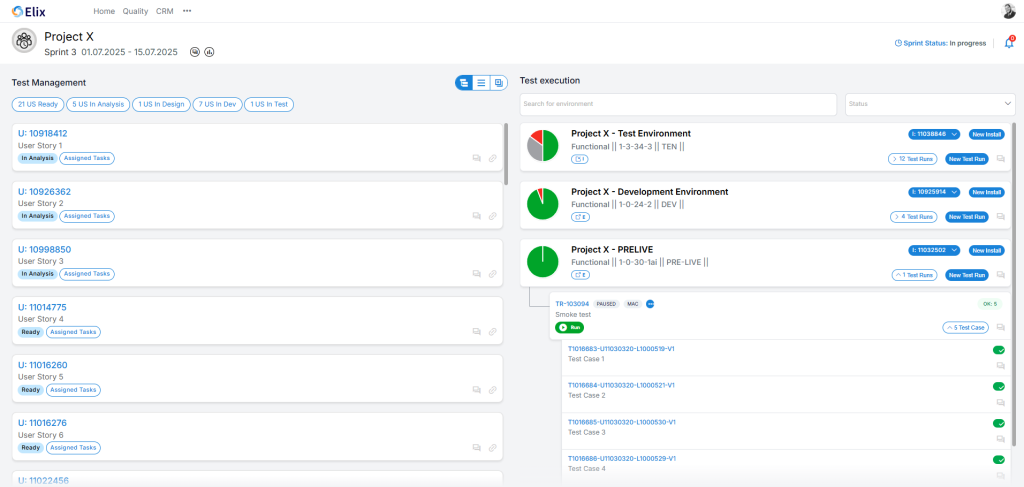
What Elix provides | Elix integrates QA management directly into Agile workflows, offering :
✅ Real-Time QA Dashboard for full sprint visibility ✅ AI Agents (Test Case Generator, Test Script Generator, Automated Test Runner, A/B Test Agent) ✅ Version Assignment & CI/CD-driven testing ✅ Structured Test Case Library ✅ Intuitive Test Case generation ✅ Environment Status Tracking (test, dev, prelive, etc.) ✅ Traceable Test Run Execution ✅ Change Request Approval Workflow
|
Impact |
|
For more details on QA Features, check our article : Test Smarter : How to Structure Your QA Process with Elix

Feature 3 : Role-based AI Agents
Why it matters |
|
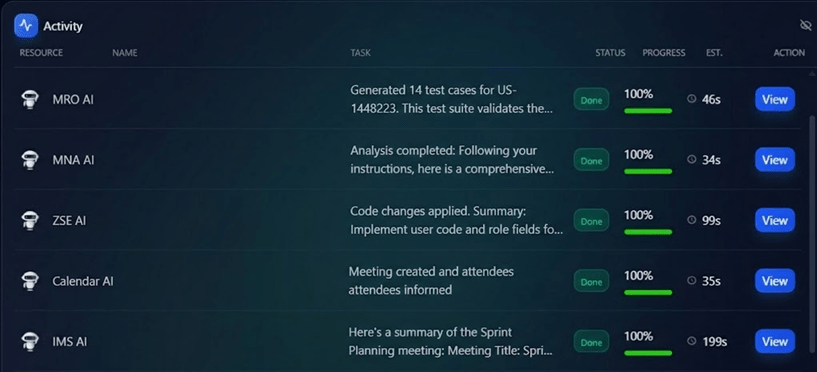
What Elix provides | Unlike traditional AI assistants that react to prompts, Elix Multi-Agent System introduces autonomous role-based AI agents that actively support the development lifecycle :
✅ AI Orchestrator Agent (routes tasks to specialized agents) ✅ Role-based AI Agents (e.g. Project Manager, Scrum Master, Developer, QA, Calendar Agent, etc.) ✅ Integration with enterprise databases and APIs ✅ Smart Workflow Execution & Monitoring ✅ AI-Driven Agile Project Management (Backlog prioritization, Sprint planning, ✅Task generation, US creation…) ✅ AI-assisted release validation ✅ Intelligent meeting scheduling ✅ AI-assisted Document Generation & Summarization ✅ Context-aware decision support
|
Impact |
|
For more details on Elix Multi-Agent System, check our article : Elix MAS: The Multi-Agent AI System for Development Teams

Final thoughts
The era of fragmented tools is coming to an end.
Tech organizations increasingly need platforms that combine:
- Agile project management
- Integrated QA workflows
- Intelligent AI automation
Within a single unified ecosystem.
Elix was designed with this vision in mind: a modular platform that streamlines the entire software development lifecycle while introducing intelligent automation through its Multi-Agent System.
✅ With Elix, tech teams can move faster, build better software, and focus on what truly matters: innovation.
Content
This guide takes you beyond marketing promises and feature lists. Inside, you’ll find a practical, principle-driven checklist that will help you evaluate platforms confidently and select one that is future-ready, modular, and truly adaptable.

Instead of one central brain, Multi-Agent Systems (MAS) offer a different approach. Intelligence is distributed across multiple autonomous agents that collaborate, adapt, and act in parallel. For business management, this enables faster decisions, higher resilience, and measurable efficiency gains.
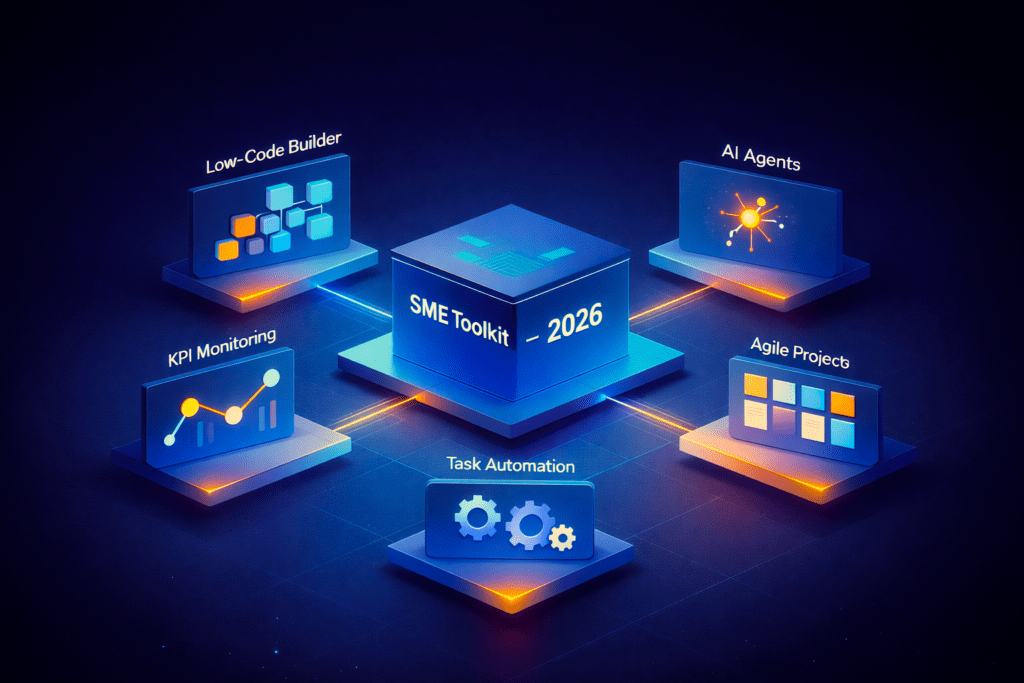
By 2026, small and medium-sized enterprises (SMEs) will face a tougher, faster, and more complex business environment than ever before. To stay competitive, SMEs must move away from fragmented tools and rigid software toward flexible, intelligent, and modular platforms. Here are the 5 must-have features that will define the modern SME toolkit in 2026.