Checklist : How to Choose the right Business Management Software
Blog
·
15/05/2026
·
Imagine your organization as a living, growing organism. Every team, every process, every department is a moving part that must work in harmony. Now imagine trying to control it with a single rigid tool that can’t adapt, or worse, one that breaks whenever you add a new function.
That’s the reality many businesses face when choosing an all-in-one Business Management Platform.
This guide takes you beyond marketing promises and feature lists. Inside, you’ll find a practical, principle-driven checklist that will help you evaluate platforms confidently and select one that is future-ready, modular, and truly adaptable.
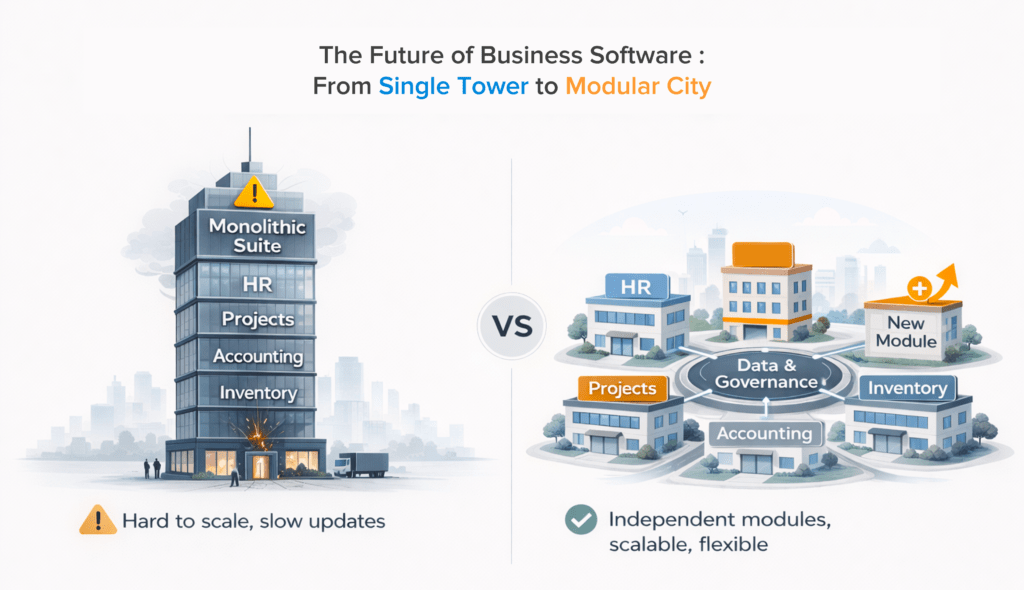
Why your Business Software should be more like a city, not a single building
Imagine your organization as a busy city. Departments are neighborhoods, teams are streets, and workflows are the traffic that keeps everything moving.
Now picture running this city from a single huge skyscraper where everything is stacked together. If one elevator breaks, HR, Finance, and Projects all come to a standstill.
This is exactly what happens with traditional monolithic business software :
- Everything tightly coupled: One change can disrupt multiple workflows.
- Difficult to scale: Adding new departments or processes often requires costly reconfiguration.
- Slow to evolve: Upgrades and new features are risky and slow to implement.
- Limited visibility: Leadership struggles to get real-time insights across the organization.
The “single skyscraper” approach may look efficient at first.
One vendor. One contract. One interface.
But as your organization grows, complexity multiplies..
Now imagine a city designed with modular districts:
- Each district (module) operates independently but shares central infrastructure like roads, utilities, and governance.
- New districts can be added without disrupting others.
- The city can expand organically while remaining efficient and well-connected.

Checklist: How to evaluate your Business Management Software
For each statement below, assign :
- 2 points = Fully supported
- 1 point = Partially supported / unclear
- 0 points = Not supported
Score Interpretation | |
41–50 points | Strategic platform |
31–40 points | Operational but limited |
21–30 points | Risk of rigidity |
0–20 points | High-risk platform |
1. Architecture & Modularity
☐ The platform offers a modular architecture where only the necessary modules are activated.
☐ Each module/ functional domain operates independently
☐ A central core ensures consistent governance and business rules across all modules.
☐ Modules can be deployed or scaled independently.
☐ The system is API-first by design.
2. Adaptability & Future readiness
☐ Workflows can be modified/ redesigned without rewriting core code.
☐ New departments or business units can be added seamlessly.
☐ The platform supports low-code or configuration-based extensions.
☐ The vendor has a clear product roadmap aligned with long-term evolution.
☐ Organizational restructuring does not require reengineering the system.
3. Scalability & Performance
☐ The platform supports multi-entity and multi-country operations.
☐ Performance benchmarks are documented and measurable.
☐ The system maintains speed under high concurrency.
☐ Modules can scale independently based on operational demand.
☐ Infrastructure flexibility (cloud, hybrid, on-premise) is available.
4. Integration & openness
☐ APIs are fully documented and accessible.
☐ Third-party integrations are supported without workaround solutions.
☐ Data export is structured and unrestricted.
☐ You can switch vendors without major disruption.
5. Security & Governance
☐ Data handling and storage comply with regulatory requirements, including GDPR and ISO standards (e.g., ISO 27001)
☐ Audit trails are available across modules.
☐ Supports role-based access control.
6. User & Data Experience
☐ Teams have real-time visibility across workflows, KPIs, and dashboards.
☐ The platform provides a modern, intuitive user experience with web and mobile accessibility.
☐ Reports can be generated, extracted, and interpreted effortlessly.
Red Flags to avoid
🚩 Architecture is unclear or not transparently explained by the vendor
🚩 Heavy customization requires modifying core code
🚩 No clear product roadmap
🚩 No performance benchmarks
🚩 Limited API documentation
🚩 Unclear Licensing model
Final Thought: Choose structural advantage
Choosing business management software is more than picking features , it’s a structural decision. The right platform should scale, adapt, and provide operational clarity without imposing rigid constraints.
Modular, micro-app-based architectures like Elix provide upgrade-safe, independent modules, giving your organization the flexibility to evolve confidently for years to come
Content
Evaluate your current or prospective platform with our checklist
Instead of one central brain, Multi-Agent Systems (MAS) offer a different approach. Intelligence is distributed across multiple autonomous agents that collaborate, adapt, and act in parallel. For business management, this enables faster decisions, higher resilience, and measurable efficiency gains.

By 2026, small and medium-sized enterprises (SMEs) will face a tougher, faster, and more complex business environment than ever before. To stay competitive, SMEs must move away from fragmented tools and rigid software toward flexible, intelligent, and modular platforms. Here are the 5 must-have features that will define the modern SME toolkit in 2026.
In any organization, work can feel like a tangled mess. Tasks are missed, deadlines are a suggestion, and no one is quite sure who's responsible for what. This state of "chaos" isn’t because your team lacks skill or effort. It’s because your internal workflows lack structure. A well-structured workflow management system can transform that chaos into clarity, improving team productivity, business efficiency, and long-term scalability.