Low-Code Builder : Accelerating Digital Transformation in 2026

Blog

·

19/06/2026

·

Reading time 4 min

In 2026, time is the most expensive resource inside any organization.


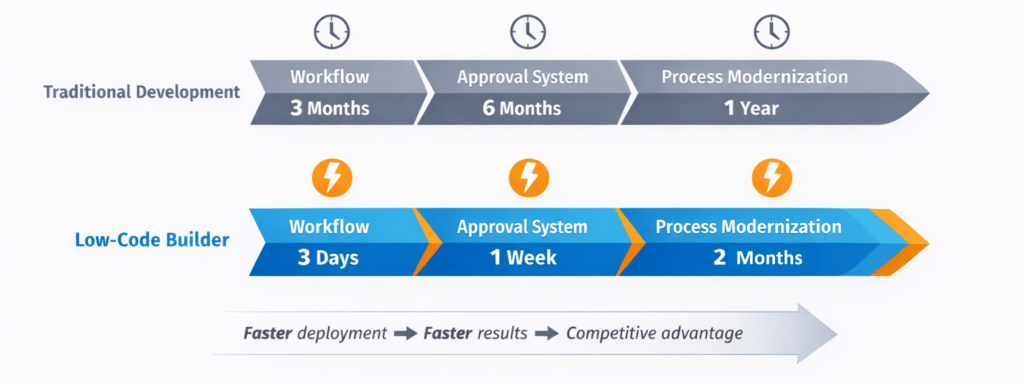
Waiting three months for a new workflow.
Six months for a custom internal tool.
A year for a process redesign.


That delay isn’t just inefficiency,  it’s lost opportunity.


Digital transformation is no longer about implementing a large system every five years.

It is about continuous adaptation. And adaptation requires speed.


This is where low-code builders enter the picture, enabling organizations to turn ideas into operational tools in days instead of months.

Low-code vs traditional development timelines
Low-code vs traditional development

What is a Low-Code Builder?

A low-code builder is a visual development environment that allows organizations to design, build, and deploy business applications with minimal hand-coding.


Low-code builders are often perceived as simple drag-and-drop tools. In reality, they act as application assembly platforms, enabling organizations to rapidly create workflows, dashboards, and internal tools while maintaining architectural control.


Core characteristics :


  • Visual modelling via graphical interfaces instead of manual coding
  • Drag-and-drop builders for UI, logic, workflows, and data
  • Automatic API generation and integration connectors
  • Collaboration between business and IT teams

Did you know?


Low-code platforms can reduce development time by up to 70% compared to traditional coding

Inside a Low-code platform : Key components

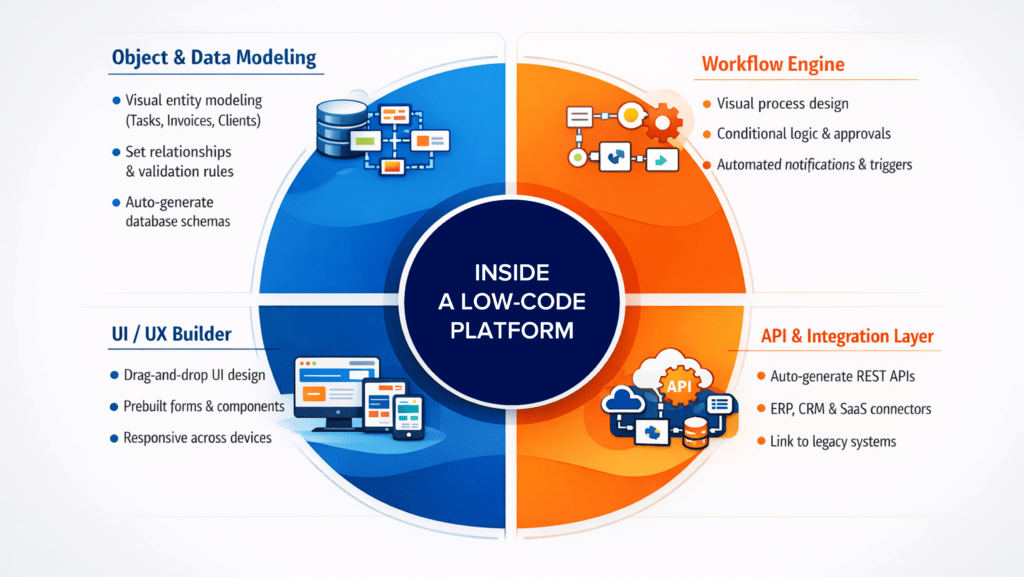
A modern low-code platform is structured around four core components that enable rapid development without sacrificing enterprise standards.

1. Object & Data Modelling

  • Define business entities visually (e.g., tasks, invoices, projects, employees, clients).
  • Configure relationships, constraints, and validation rules without writing SQL.
  • Automatically generate database schemas and integrate with existing data sources.

2. Workflow Engine

  • Design multi-step processes using visual editors.
  • Include conditional logic, approval chains, notifications, and triggers.

3. UI/UX Builder

  • Build forms, lists, reports and application pages with drag-and-drop.
  • Prebuilt components like tables, buttons, and text fields accelerate development.
  • Responsive layouts ensure cross-device consistency without extra coding.

4. API & Integration Layer

  • Auto-generate REST APIs for each object and workflow.
  • Connect with ERP, CRM, or legacy systems using visual integration tools.
  • Supports external SaaS and on-premise data sources
inside low code platform

The rise of the citizen developer

A citizen developer is typically a business professional with strong domain expertise who uses low-code tools to build or configure applications without writing extensive code.


The rise of citizen developers does not eliminate the role of IT. In fact, successful low-code adoption depends on strong collaboration between business teams and developers.


Each group plays a complementary role :

Role

Contribution

Business Experts

Define processes, workflows, and operational needs

Citizen Developers

Configure applications using low-code tools

IT Teams

Ensure security, governance, integrations, and scalability


Why Citizen Development matters for digital transformation ?


Faster Innovation cycles
Business teams can experiment, prototype, and deploy solutions without waiting for long development queues.


Reduced IT Backlog
Low-code builders allow IT departments to offload smaller application requests while focusing on more complex systems.


Better alignment between Technology & Operations
Applications are designed closer to the people who actually use them, improving usability and efficiency.


Continuous process improvement
Workflows and tools can evolve rapidly as business needs change.

Real use cases for Low-Code Builders

Low-code platforms are widely adopted to accelerate the development of internal tools and automate operational processes.


The following use cases represent some of the most common and high-impact applications across organizations.

Use case

Typical applications

Workflow & Approval Automation

·         Purchase approval workflows

·         Expense validation processes

·         HR requests (leave management, onboarding, contract approvals)

·         Procurement approval chains

·         Document validation workflows

Internal Business Applications

·         Project and task management tools

·         Internal service request portals

·         Operational tracking systems

·         Resource planning applications

·         Department-specific management tools

Data Collection

& Management

·         Surveys and digital forms

·         Audit and compliance reporting systems

·         Incident reporting platforms

Operational Dashboards

& Reporting

·         Project progress monitoring tools

·         Financial reporting systems

·         Service-level/ SLA monitoring platforms

Did you know?


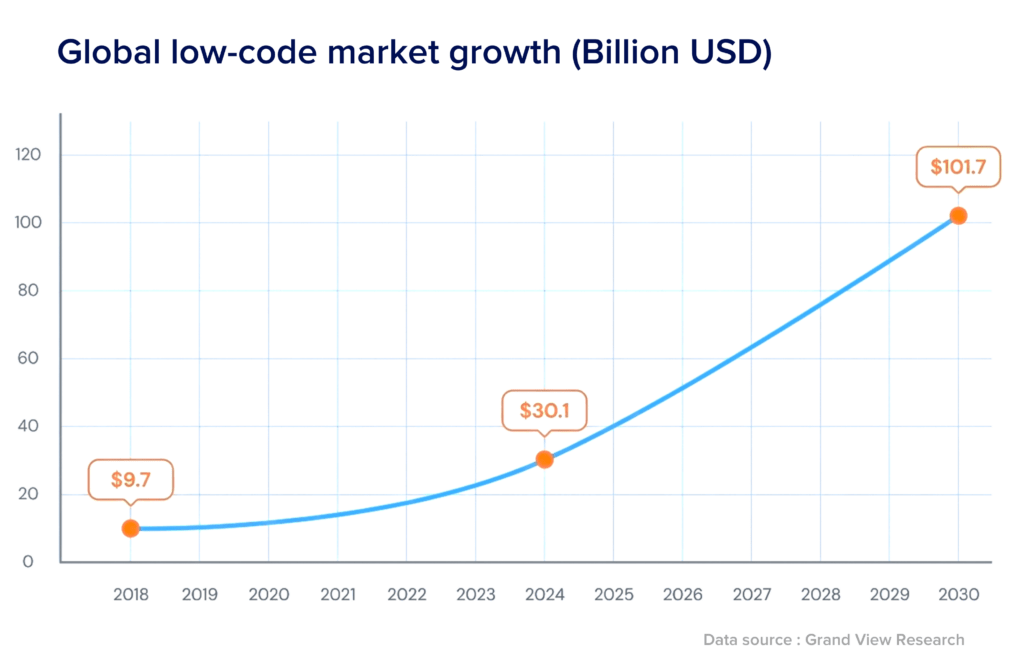
Low-code market will reach $101.7 billion by 2030, reflecting widespread enterprise adoption

low code market

Final thoughts

In 2026, the real competitive edge is about speed, adaptability, and the ability to act now.


By combining visual development, workflow automation, API integration, and citizen development, low-code platforms like Elix are turning digital transformation from a long-term project into an ongoing, iterative process.


Low-code builders give organizations the power to:


  • Quickly transform ideas into operational applications
  • Empower business users to innovate while IT ensures governance
  • Automate workflows and collect actionable data
  • Modernize legacy systems without disrupting operations

Content

Loading...

With Elix, turn your ideas into operational tools in days