Multi-Agent System Explained: Top 5 Benefits for Business Management

Blog

·

23/01/2026

·

Reading time 4 min

Today’s businesses operate in fast-changing, highly interconnected environments. Centralized systems, where one engine makes all decisions often struggle with scale, speed, and resilience. As complexity increases, these systems become bottlenecks rather than enablers.


Multi-Agent Systems (MAS) offer a different approach. Instead of one central brain, intelligence is distributed across multiple autonomous agents that collaborate, adapt, and act in parallel. For business management, this enables faster decisions, higher resilience, and measurable efficiency gains.

What's a Multi-Agent System (MAS) ?

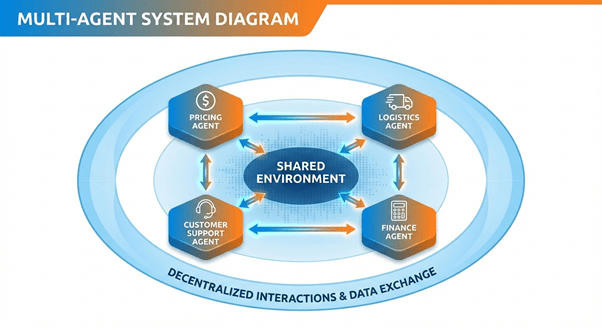
A Multi-Agent System is a system composed of multiple autonomous agents interacting within a shared environment. Each agent :


  • Perceives relevant information
  • Makes local decisions
  • Communicates with other agents
  • Acts independently toward a goal


Rather than being centrally controlled, system behaviour emerges from agent interactions.


In business terms, agents resemble specialized digital roles; pricing, logistics, customer support, finance; each focused on its domain while coordinating with others.

MAS diagram

How Multi-Agent Systems Work

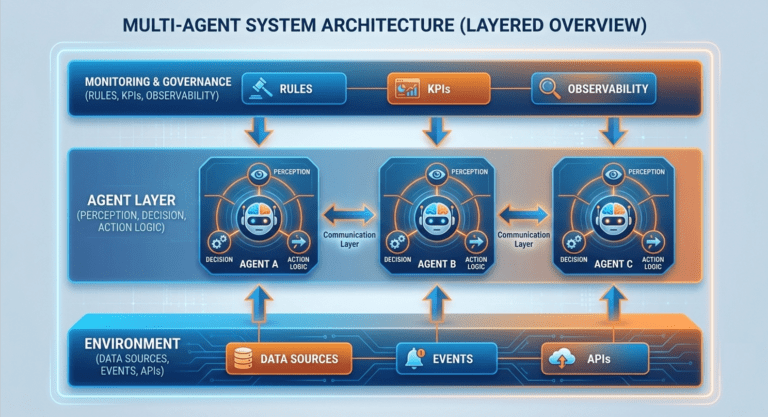
A typical Multi-Agent System is built on 4 core components :


  • Agents : Each agent has its own goal, decision logic, and sometimes learning capability.
  • Environment : The space where agents operate: databases, APIs, real-world sensors, business events.
  • Communication Mechanism : Agents exchange information using messages, events, or shared state.
  • Coordination & Governance : Rules or protocols ensuring agents collaborate effectively (negotiation, auctions, and priorities).


Unlike traditional workflows, control is distributed, enabling parallel execution and adaptability.

MAS Architecture

Top 5 Benefits for Business Management

1. Scalable Operations without Bottlenecks

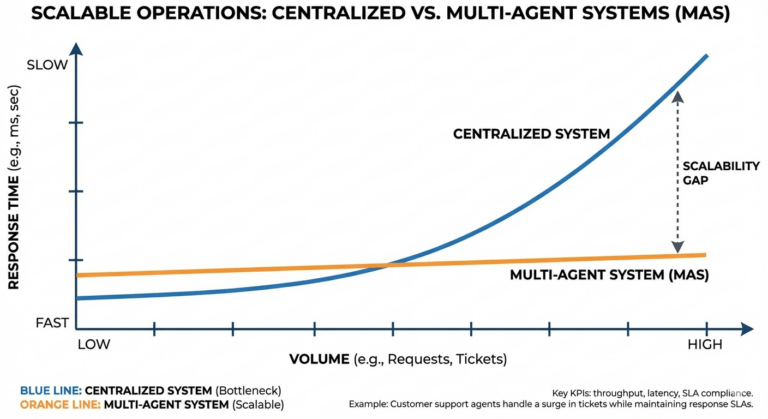
In centralized systems, every decision must pass through a single bottleneck. As workload grows, response times increase sharply. Multi-Agent Systems scale differently.


Because agents operate independently, workload is naturally parallelized. Adding capacity often means adding agents, not redesigning the entire system.


Business impact:

  • Faster response under peak demand
  • Linear or near-linear scalability
  • Reduced system congestion


Key metrics to track:

  • Task throughput (tasks/hour)
  • Average processing latency
  • SLA compliance rate during peak load


Example:
A customer service MAS routes incoming tickets to specialized agents (billing, technical, onboarding). During promotions, the system absorbs a 3× increase in volume while maintaining response SLAs.

2. Built-In Resilience and Fault Tolerance

Centralized systems fail hard. If the core component breaks, everything stops.

In a Multi-Agent System, failure is localized. If one agent goes offline, others continue operating, often compensating dynamically.


Business impact:

  • Higher system availability
  • Reduced downtime costs
  • Graceful degradation instead of full outages


Key metrics:

  • Mean Time to Recovery (MTTR)
  • System uptime (%)
  • Degraded-mode throughput


Example:
In a logistics MAS, if a warehouse agent becomes unavailable, routing agents automatically redirect orders to alternative locations.

3. Faster, Context-Aware Decision-Making

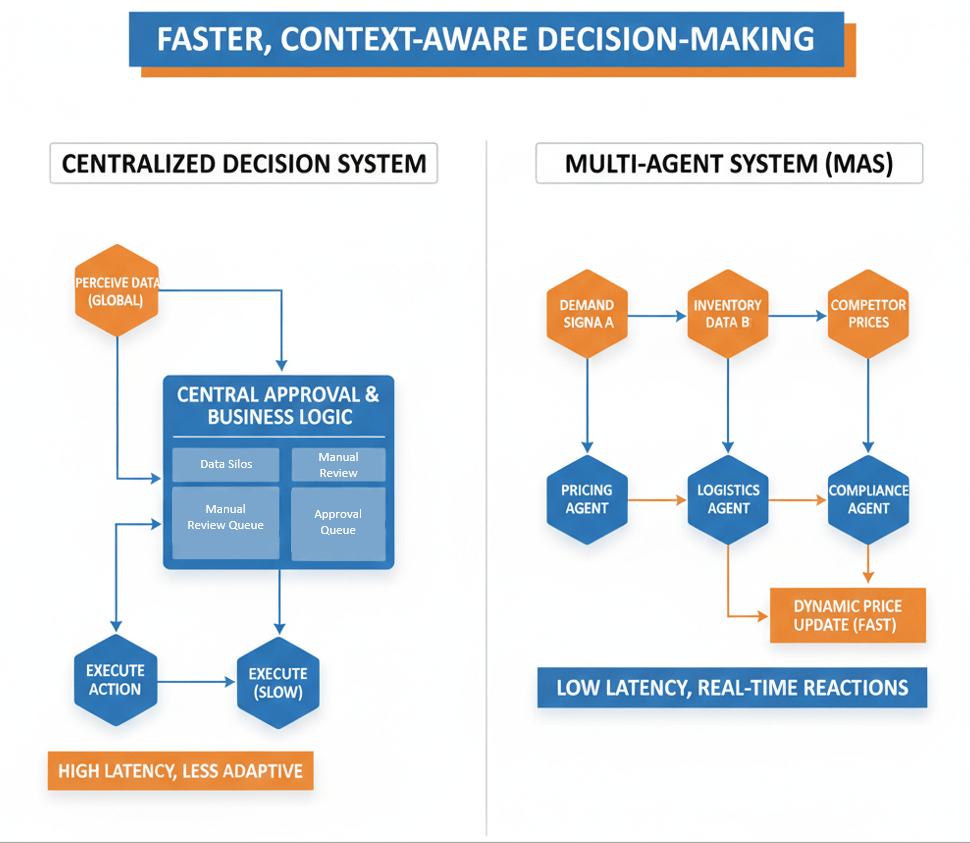
Centralized decision engines often rely on delayed or aggregated data. Agents, however, act close to the source of information.


This reduces decision latency and increases relevance.


Business impact:

  • Real-time operational decisions
  • Improved responsiveness to market changes
  • Reduced managerial overload


Key metrics:

  • Decision latency
  • Error rate
  • Revenue or cost impact per decision


Example:
Dynamic pricing agents update prices in minutes based on demand signals rather than waiting for nightly batch processes.

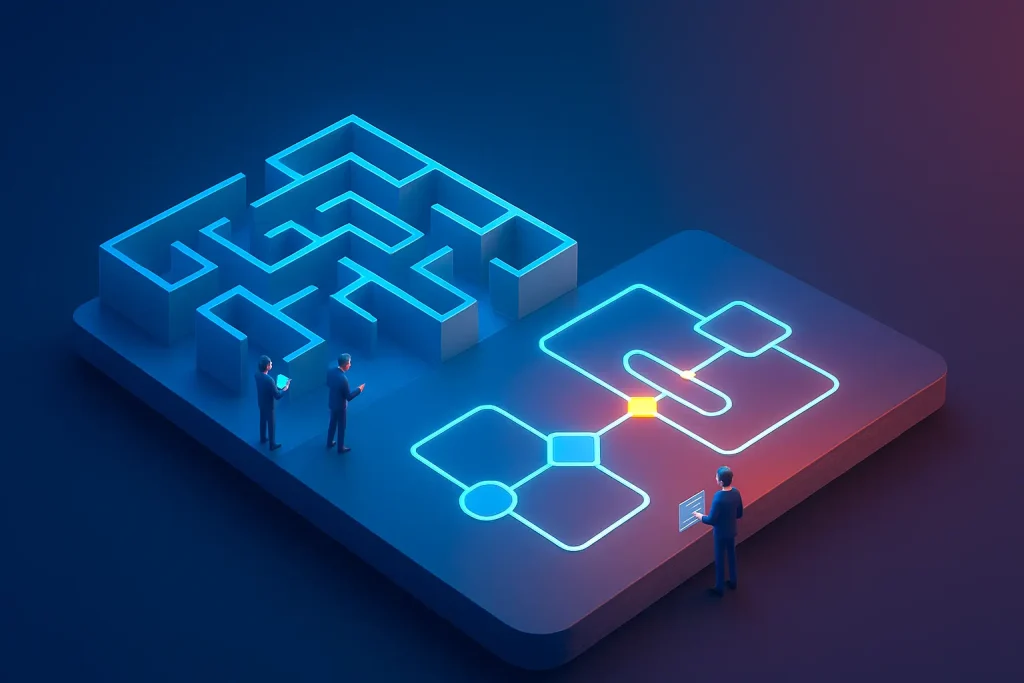
Faster decision-making with AI Agents

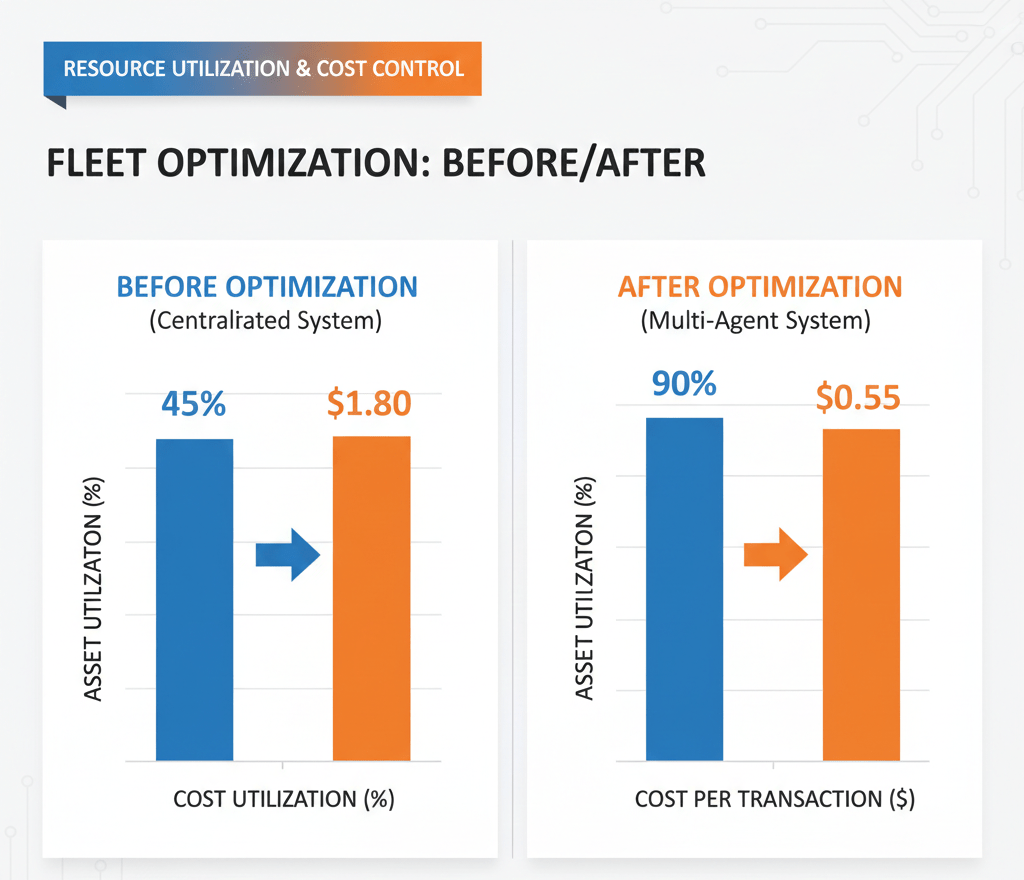
4. Better Resource Utilization and Cost Control

Agents can negotiate and coordinate resource usage in real time, reducing waste and idle capacity.


Common coordination mechanisms include:

  • Auctions
  • Priority rules
  • Market-based allocation


Business impact:

  • Lower operational costs
  • Higher asset utilization
  • Reduced energy and logistics waste


Key metrics:

  • Resource utilization rate (%)
  • Cost per transaction
  • Energy consumption per unit


Example:
Fleet agents dynamically assign vehicles based on proximity, load, and fuel efficiency, reducing empty miles.

fleet optimization with AI

5. Continuous Adaptation and Learning

When agents learn from outcomes, the system improves continuously without major redesigns.


Business impact:

  • Faster adaptation to market shifts
  • Incremental performance gains
  • Reduced need for manual reconfiguration


Key KPIs:

KPI uplift over time, time-to-adapt


Example:

Marketing agents reallocate budgets daily based on campaign performance, continuously improving ROI.

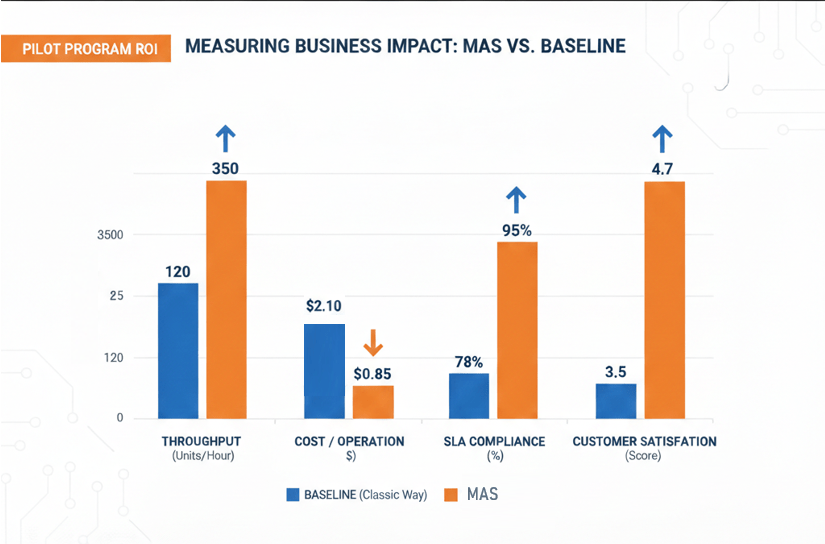
Measuring ROI and Business Impact

To justify investment, MAS initiatives should be data-driven from day one.


➡️ Recommended approach :

  • Run pilot programs on high-impact processes
  • Compare MAS vs baseline using A/B testing
  • Track operational and financial KPIs


➡️ Core KPIs to monitor :

  • Throughput and latency
  • SLA adherence
  • Cost per operation
  • Customer satisfaction (CSAT/NPS)
AI agents ROI

Implementation Considerations

While powerful, MAS requires thoughtful implementation.

Key challengesBest practices
  • Coordination complexity
  • Observability and debugging
  • Security and trust between agents
  • Governance and accountability
  • Start with a hybrid model
  • Invest in monitoring and simulation
  • Define agent responsibilities clearly
  • Roll out incrementally

Conclusion

Multi-Agent Systems (MAS) provide a strong response to the growing complexity of modern business management.


By distributing intelligence across autonomous agents, organizations achieve greater scalability, resilience, faster decision-making, improved resource utilization, and continuous adaptation.

Turning these advantages into real-world value, however, requires a platform built for business realities, not just technical theory.


In the next article, we will introduce Elix MAS, a practical Multi-Agent implementation designed for enterprise environments. We will show how it makes agent collaboration operational, governed, and measurable, bridging the gap between concept and execution.


Stay tuned!

Content

Loading...

Curious how your business can benefit from a Multi-Agent System?