Every day, professionals receive dozens of emails that quietly contain tasks:
- “Can you send the report by Thursday?”
- “Let’s review this next week.”
- “Please prepare a draft before our next meeting.”
Most of these requests never become structured tasks or calendar events. They remain buried in inboxes, flagged, forwarded, or even forgotten.
As productivity expert David Allen famously stated:
“Your mind is for having ideas, not holding them.”
At Elix, we see this as a structural inefficiency, not a user failure. As part of our AI exploration efforts, we asked a simple question : What if your calendar could understand your emails and schedule tasks automatically?
What Is an AI Task Management Agent?
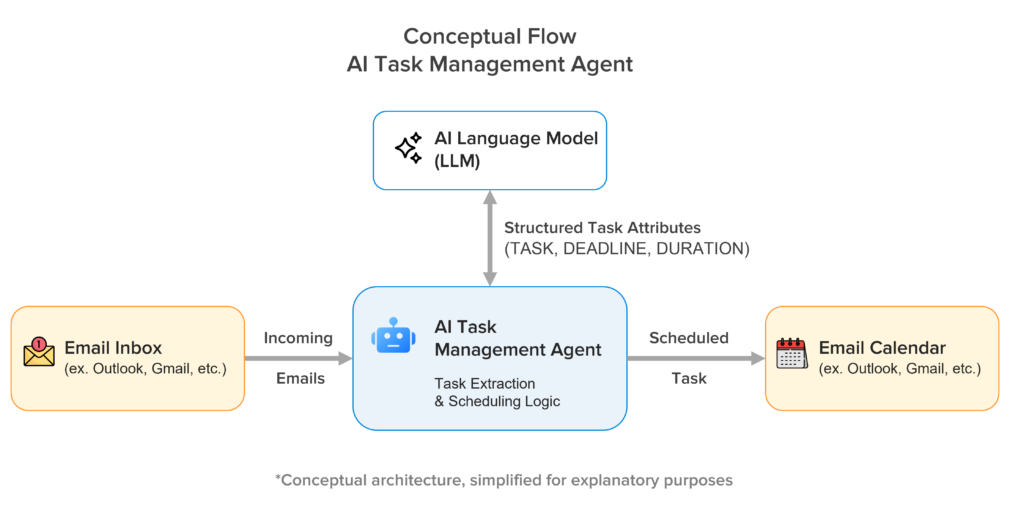
An AI task management agent is a system capable of :
- Reading unstructured text (such as emails)
- Understanding intent, deadlines, and effort
- Converting that information into structured actions
Instead of asking users to read an email, identify the task, open a task manager or calendar and manually schedule time, the AI agent performs these steps automatically, in seconds.
➡️ This approach shifts task management from manual input to intent-driven automation.

How AI Turns Emails into Scheduled Tasks
Step 1 : Understanding Human Language
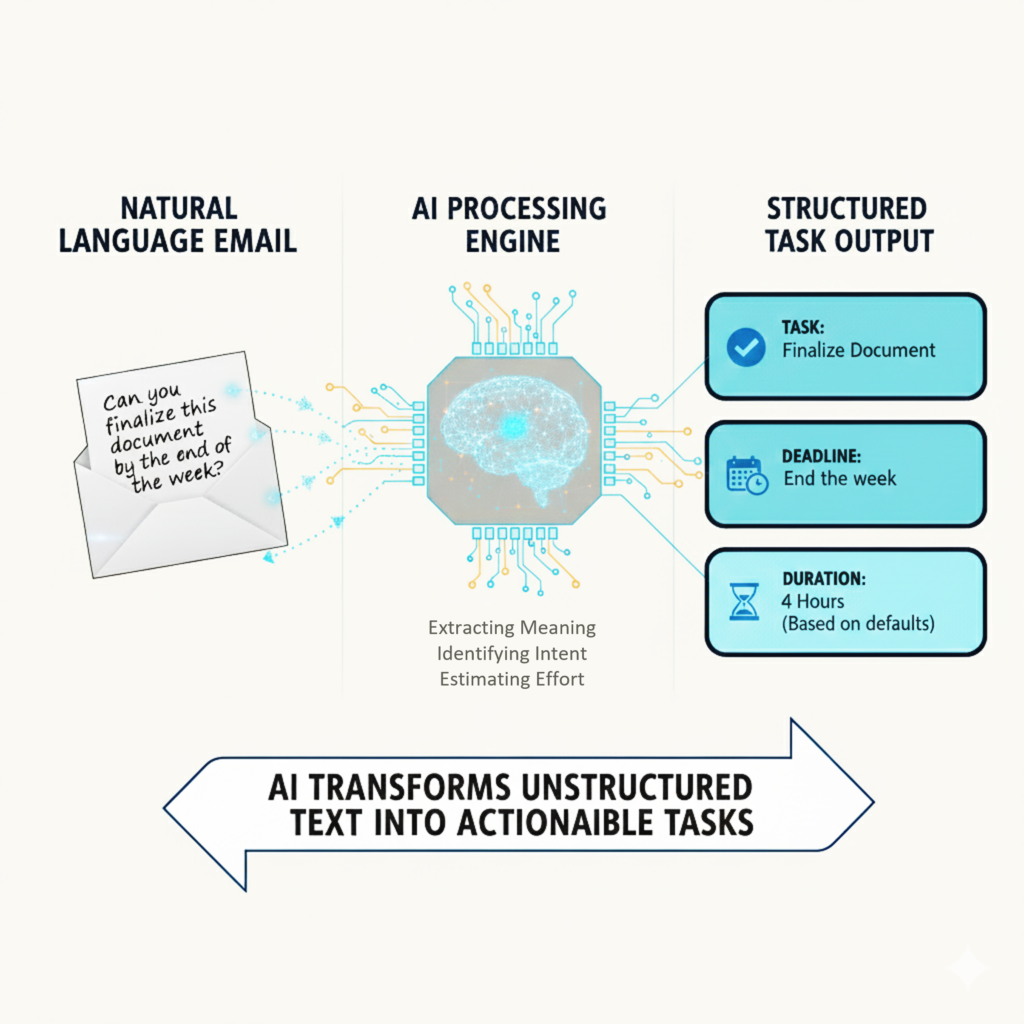
Emails are written in natural language, not structured forms. AI models can now extract meaning from phrases like : “Can you finalize this document by the end of the week?”
From a single sentence, the agent identifies:
- Task: Finalize document
- Deadline: End of the week
- Estimated duration: Based on context or defaults
This transforms unstructured text into a simple, usable task format.

Step 2 : Intelligent Scheduling
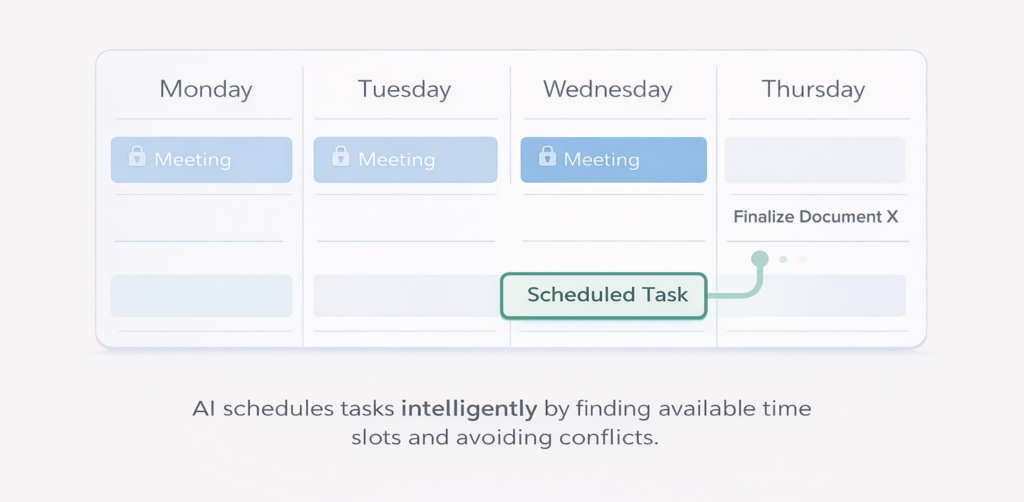
Rather than blindly adding events, the AI Agent is designed to follow these principles :
- Ingest last N emails and extract (task, deadline, duration).
- If time is unspecified, assume deadline time 17:00 local (configurable).
- Schedule tasks before deadline, avoiding overlaps with existing events.
- For fixed times (explicit timestamps in email), place exactly at that time.
If information is missing or ambiguous, the system applies smart defaults (for example, scheduling before the deadline at a reasonable time).
This is where intelligence, not just automation, makes the difference.

What We Learned from This AI Experiment
1. AI understands Natural Language Better Than Expected
Modern AI models can extract tasks accurately even when emails are informal, vague, or conversational. Requests that are not explicitly written as tasks can still be correctly identified and transformed into actionable work.
2. Smart Defaults are Essential
In real-world emails, information is often incomplete. Deadlines may be vague, and task duration is rarely specified. Therefore, Intelligent defaults are critical to prevent user friction while avoiding constant clarification requests.
| Missing / Unclear Input | Detected Condition | Smart Default Applied |
| No explicit deadline | Email mentions “end of the week” | Deadline set to Friday, 5:00 PM |
| No task duration | Similar tasks usually take 1–3 hours | Duration set to 2 hours |
| No priority defined | Task impacts reporting or management review | Priority set to High |
| No scheduling preference | Free focus time available before deadline | Task scheduled in next available focus slot |
| Vague description | Task created from an email | Task title auto-generated from email subject |
3. Traceability Is a Must
For AI-powered task management to be adopted in professional and enterprise contexts, transparency is mandatory. Clear and human-readable logs of processed emails, extracted tasks and scheduled events are essential for enterprise trust, troubleshooting, and compliance.
4. Limitations are as Important as Capabilities
As with any early-stage AI exploration, this experiment has clear boundaries :
⛔ No task prioritization yet (urgent vs. deep work)
⛔ No visual distinction between AI-created and manually created calendar events
⛔ Designed for individual productivity, not shared inboxes or team workflows
How This Fits into the Elix Vision
While this AI agent is not yet part of Elix, the learnings already shape how Elix’s Agile Project Management and Ticketing & Task Management modules are evolving.
They reinforce a clear direction :
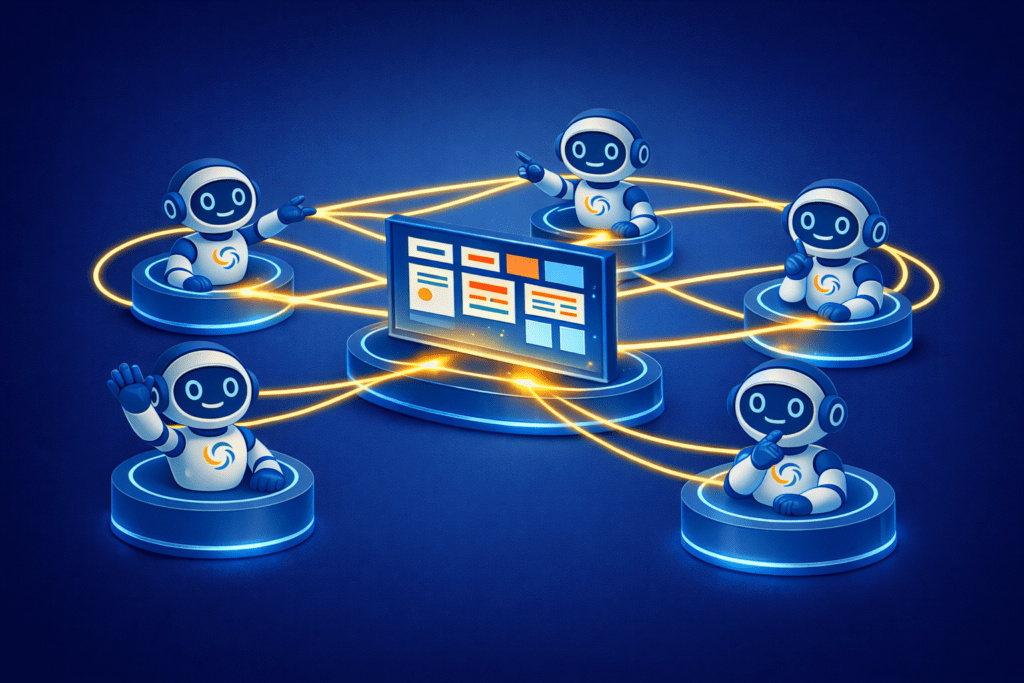
- Modular AI agents, designed to plug naturally into Elix’s micro-app architecture (projects, sprints, tickets, tasks)
- Priority-aware scheduling, directly connected to SLAs, sprint commitments, and business rules already managed in Elix
- Adaptive planning, where tasks, tickets, and sprint backlogs can be reorganized dynamically as constraints change
- Secure and auditable AI, aligned with Elix’s enterprise-grade requirements and public-sector standards
➡️ This approach reflects Elix’s broader ambition : Building Management Systems that evolve with organizations, rather than rigid tools that require constant manual effort.
The Future of Task Management Is Intent-Driven
Traditional task management assumes that users must explicitly create and manage every task. AI challenges that assumption.
Turning emails into scheduled tasks is just one example, but it clearly shows how AI agents can reshape everyday work. This AI task management agent demonstrates what becomes possible when software understands language, context, and time.
While not yet an Elix feature, it reflects a direction we strongly believe in: Less manual coordination. More intelligent execution.
As Elix continues to evolve, experiments like this help shape a future where productivity tools work with you, not against your attention.
Content
Imagine if every employee had an assistant able to anticipate their needs, execute complex tasks, and deliver real-time insights. This is no longer science fiction. Conversational and operational AI is already here, ready to transform business management. So, how can AI become your right-hand partner in daily business?