The Modern SME Toolkit : 5 Must-Have Features for 2026
Blog
·
12/01/2026
·


 · Copy Link
 By 2026, small and medium-sized enterprises (SMEs) will face a tougher, faster, and more complex business environment than ever before.
Over 70% of organizations will be forced to accelerate digital transformation to remain competitive, according to global industry analysts.
At the same time, market volatility, talent shortages, rising customer expectations, and increasing regulatory pressure mean that doing more with less is a survival requirement.
The winning SMEs won’t necessarily be the biggest, but the most agile, automated, and data-driven.
To stay competitive, SMEs must move away from fragmented tools and rigid software toward flexible, intelligent, and modular platforms. Here are the 5 must-have features that will define the modern SME toolkit in 2026.
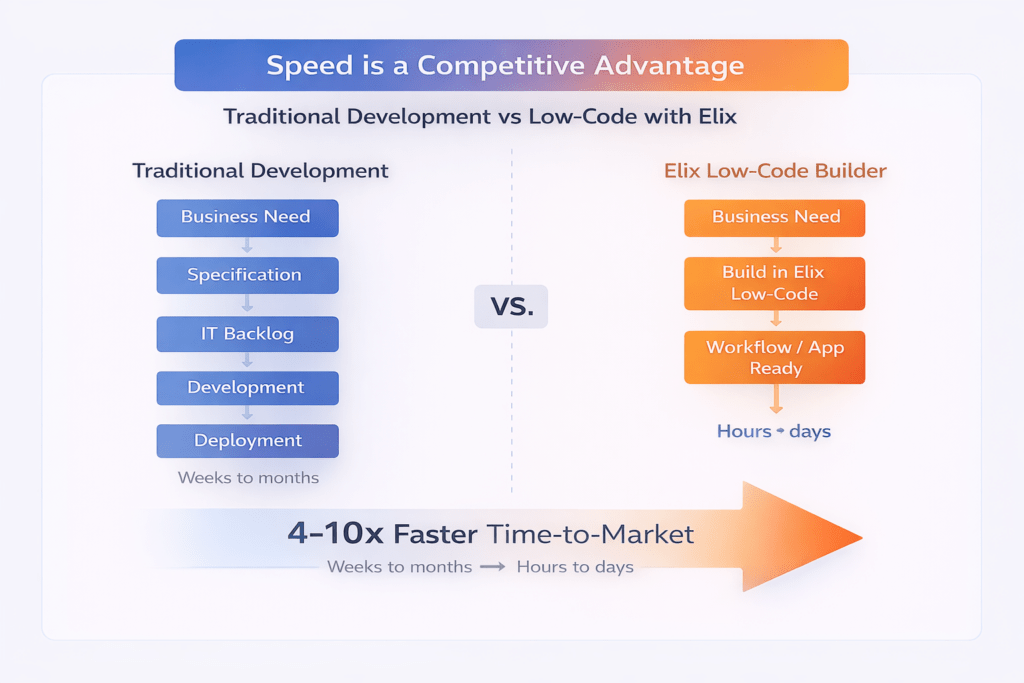
1. Low-Code Builder : Speed is a competitive advantage
The need
In 2026, business needs evolve faster than IT backlogs. SMEs can’t afford months of development for every new workflow, app, form, or graph.
What SMEs must adopt
A low-code / no-code builder that allows business teams to:
- Create and adapt applications quickly
- Model workflows without heavy development
- Respond instantly to operational or regulatory changes
Low-code is no longer just about saving costs, it’s about time-to-market.
How Elix delivers
Elix includes a built-in Low-code Builder that enables SMEs to :
- Generate business objects, tables, lists and forms
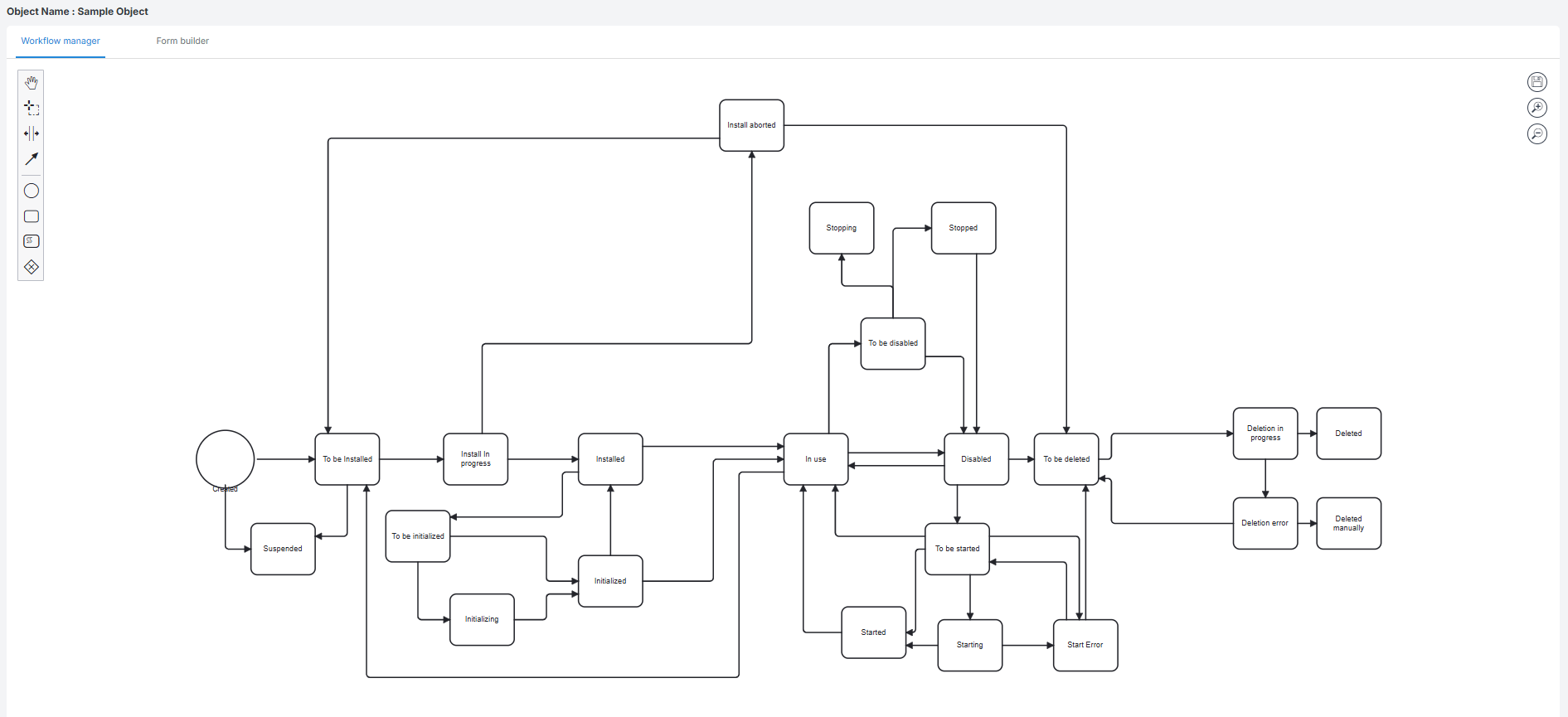
- Create & personalize business Workflows via a visual Designer (BPMN)
- Create micro-apps and interfaces independently
- Adapt processes without touching core code
- Create APIs and endpoints automatically
➡️ Result : faster innovation, less dependency on IT, and continuous evolution.
2. AI Agents for Better software delivery
The need
By 2026, SMEs will face increasing pressure to deliver software faster, with higher quality and fewer resources. SMEs need AI that doesn’t sit on the side as a chatbot, but actively supports delivery execution across the software lifecycle.
What SMEs must adopt
To remain competitive, SMEs must adopt AI-assisted delivery capabilities that :
- Accelerate requirement analysis and backlog preparation
- Standardize and improve the quality of user stories and test assets
- Reduce repetitive manual effort in QA and testing
- Integrate AI directly into project and delivery workflows
The goal is not full automation, but AI-augmented teams that move faster with better consistency.
How Elix delivers
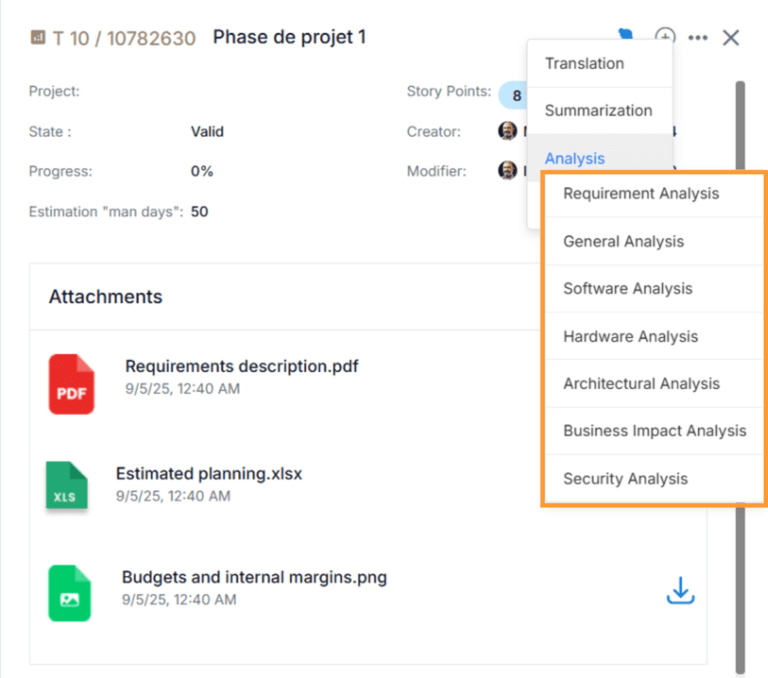
Elix embeds pre-configured AI Agents directly into its project and agile management environment, supporting key delivery activities :
- Requirement Analysis Agent : Transforms raw business needs into structured, actionable requirements using project and company context.
- User Story Writing Agent : Converts high-level requirements into clear, execution-ready user stories aligned with agile standards.
- Test Case Generation Agent : Automatically produces comprehensive test cases based on requirements and user stories to improve coverage and consistency.
- Test Script Generation Agent : Generates automated test scripts in minutes, accelerating QA cycles and supporting test-driven development.
➡️ Result : Faster delivery, improved quality, and reduced delivery friction, without disrupting existing team roles or processes.
3. KPI-Driven Management & real-time monitoring
The need
By 2026, SMEs can no longer rely on static reports or end-of-month reviews to steer their business. Without live KPIs, SMEs react too late, when delays and cost overruns have already impacted results.
What SMEs must adopt
SMEs need a KPI-driven management approach supported by tools that enable them to :
- Monitor performance in real time across projects, teams, and processes, all in one place
- Define KPIs aligned with strategic and operational objectives
- Detect risks, bottlenecks, and deviations early
KPIs should be actionable and contextual, not just numbers displayed on dashboards.
How Elix delivers
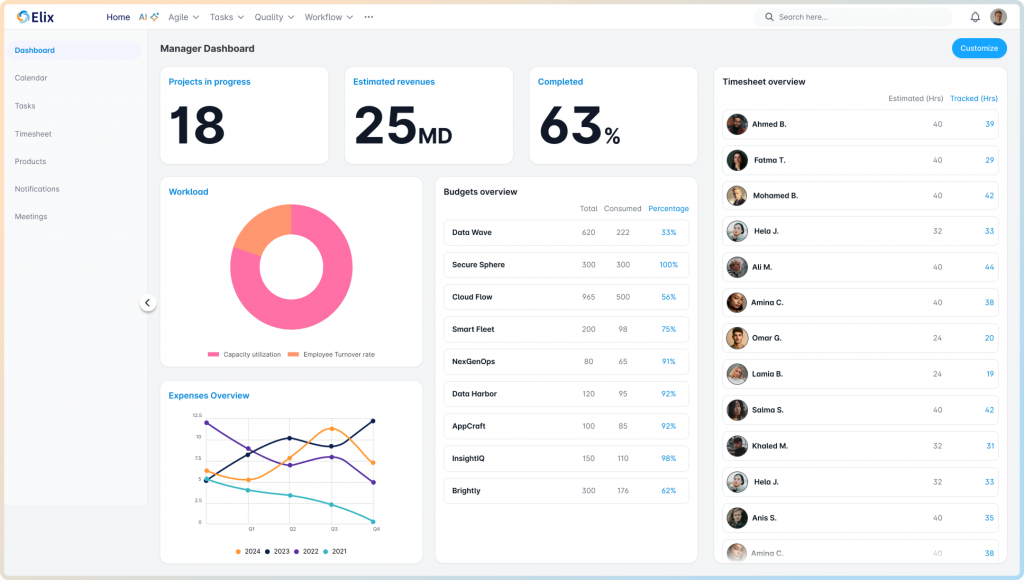
Elix embeds KPI-driven management directly into daily operations by providing :
- Pre-defined, configurable, real-time dashboards fed by live operational data
- KPI tracking linked to projects, tasks, sprints and resources
- Exportable reports for management and partners (PDF/ Excel)
➡️Result : Continuous monitoring instead of periodic reporting.
4. Agile Project & Task Management : Execution matters
The need
Strategy without execution is useless. In 2026, SMEs must execute faster while managing distributed teams and evolving priorities.
What SMEs must adopt
An Agile Project Management approach supported by tools that enable:
- Sprint planning and backlog management
- Real-time task tracking
- Clear ownership and accountability
Agility is no longer just for IT teams, it’s a company-wide mindset.
How Elix delivers
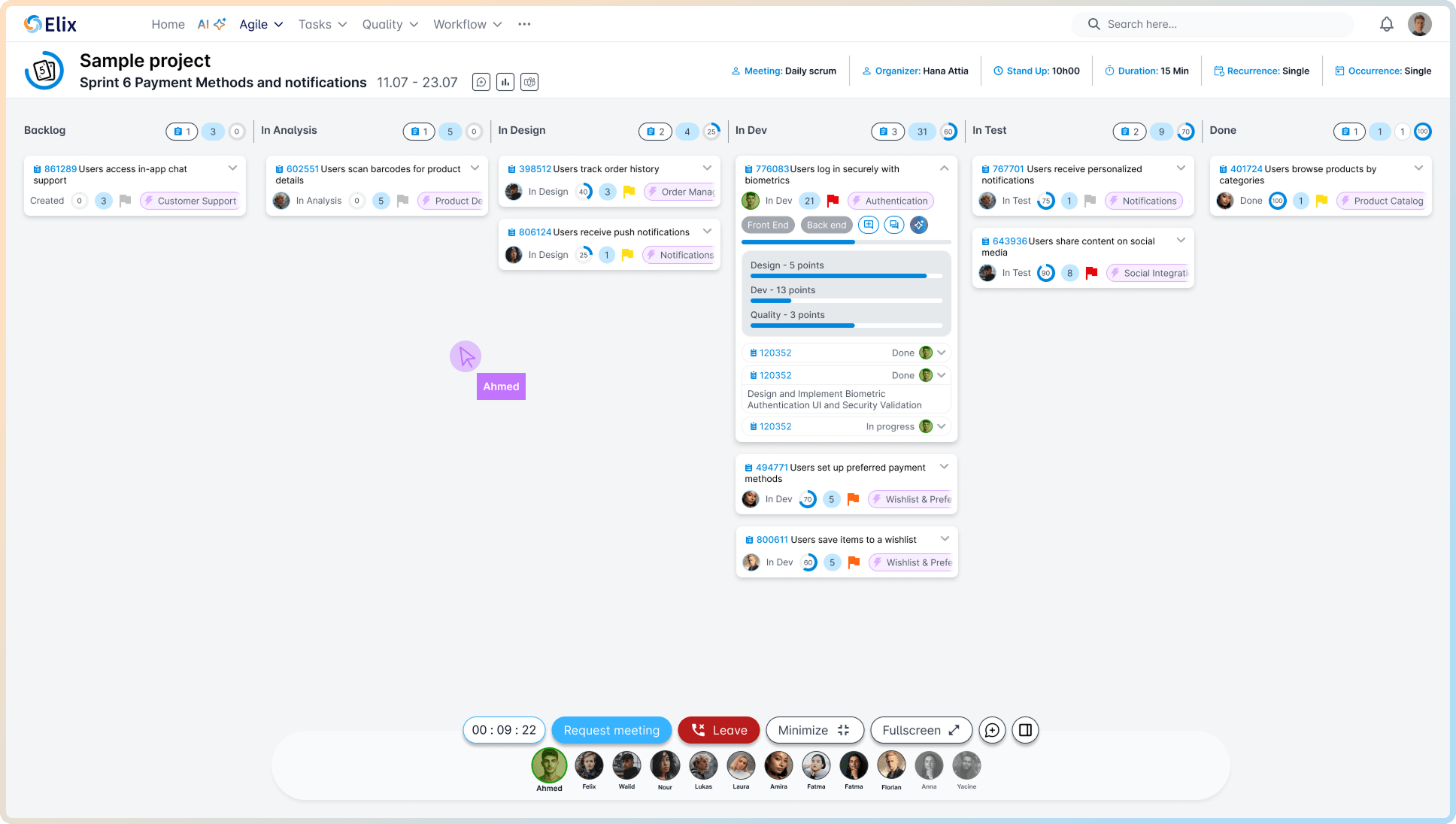
Elix is designed for Agile delivery, combining powerful project management tools :
- Sprint Management : Plan, organize, and execute sprints with drag-and-drop boards, story prioritization, and real-time updates, all in a centralized workspace.
- AI-Powered Backlog Management : Elix transforms high-level themes into actionable epics and user stories, complete with descriptions and acceptance criteria.
- Budget Control : Track total budgets versus consumption across epics, sprints, and features in real time.
- Burndown Charts : Visualize sprint progress with dynamic charts showing real vs. ideal lines and daily story points burned.
- Interactive Agile Meeting Dashboards : Facilitate Agile ceremonies with visual dashboards, progress sliders, and automatic effort logging into timesheets.
- Advanced Poker Estimation : Supports cross-functional story planning and estimation across developers, testers, and designers.
- Scrum-of-Scrum GANTT Charts : Visualize inter-team dependencies and timelines with dynamic GANTT views for scaled Agile.
- Team & Role Management : Define teams, assign roles, and manage permissions to reflect your organizational structure.
➡️Result : better alignment, higher productivity, and fewer execution gaps.
5. Task Automation : Eliminate friction, not jobs
The need
Manual, repetitive tasks drain time, energy, and morale. By 2026, SMEs that still rely on manual operations will fall behind.
What SMEs must adopt
Smart task automation to :
- Reduce human error
- Speed up operations
- Free teams for higher-value work
Automation should simplify work, not complicate it.
How Elix delivers
Elix enables end-to-end automation across processes, turning workflows into actionable systems:
- Workflow-Based Task Execution : Design and automate tasks using Elix’s BPMN Editor, with drag-and-drop elements like start points, gateways, and approvals.
- AI-Powered Backlog & Task Automation : Automate task creation, prioritization, notifications, and approvals. For example, sending an automatic approval request once a document is uploaded or notifying the next team member when a task is complete.
- Automated Validations & Approvals : Ensure compliance and consistency without manual intervention.
- Seamless API Integrations : Connect with external systems to keep data flowing smoothly and avoid manual duplication.
- Bottleneck Elimination : Clear paths from start to finish reduce delays and increase visibility for all stakeholders.
➡️Result: smoother operations and more engaged teams.
The future-ready SME toolkit, delivered by Elix
In 2026, competitive SMEs will not be defined by the number of tools they use, but by how well those tools work together.
The future belongs to SMEs that invest today in agility, intelligence, and scalability.
Elix is built for that future, bringing everything into a single, coherent platform:
- Low-code flexibility
- AI-driven intelligence
- Real-time monitoring
- Agile execution
- End-to-end automation
Content
 Business Management
Many software development companies still rely on a patchwork of tools that slows teams down instead of accelerating them. The solution? A unified platform built for modern development teams. Discover the top 3 must-have features for Tech companies.
 Future of Software
Digital transformation is no longer about implementing a large system every five years. It is about continuous adaptation. And adaptation requires speed. This is where low-code builders enter the picture, enabling organizations to turn ideas into operational tools in days instead of months.
 Business Management
This guide takes you beyond marketing promises and feature lists. Inside, you’ll find a practical, principle-driven checklist that will help you evaluate platforms confidently and select one that is future-ready, modular, and truly adaptable.
Start building your 2026-ready SME toolkit today with Elix